RTX 5090 one-card flagship
168.4 write tok/s from 32 GB of GDDR7, if the 12V-2x6 clip is actually latched.
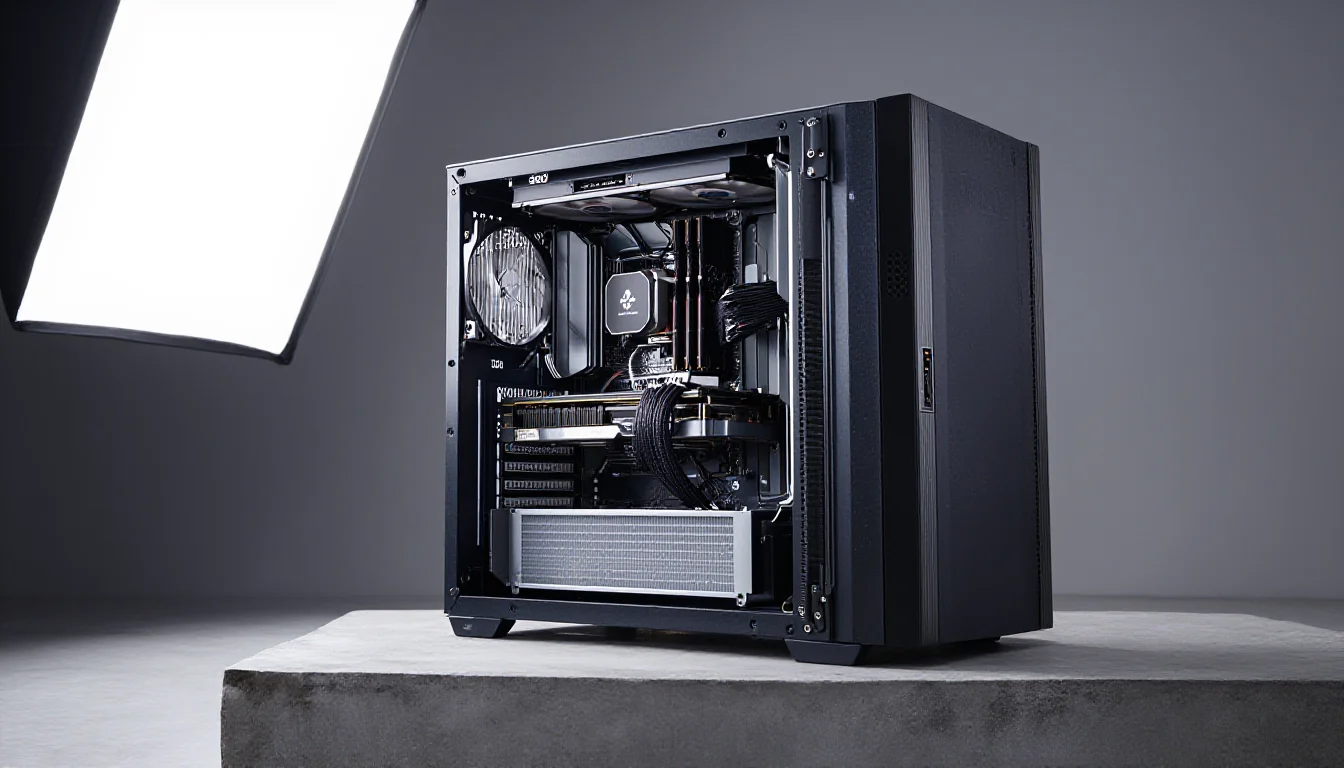
- Total price
- $8,500
- VRAM
- 32 GB + 64 GB System RAM
- Write tok/s
- 168.4
- Read tok/s
- 5803
- Load / idle power
- 700 / 96 W
- Noise
- 41 dBA
- Cost per million tokens
- 0.062
- Break-even
- 558 days
- Electricity, 4 h/day
- $258.42
- Electricity, 24 h/day
- $919.8
- Quant and context
- IQ4_XS · 48K
- Runtime
- CUDA
- Evidence
- Measured
Overview
Blackwell's 32 GB flagship is the fastest single socket in this catalog: 168.4 generated tokens per second, 5803 on the prefill path, and a published 700 W system budget at $8500. An IQ3_S 70B checkpoint sits inside the framebuffer with a short cache, but a 125B MoE at IQ4 still spills. Seat the Vertex GX-1200 lead until the clip clicks, skip every piggy-back adapter, and leave the Meshify front free for the 360 mm radiator.
Best for
A buyer who wants the highest one-GPU write rate and can hear a 700 W tower.
Tradeoffs
The card is most of the $8500, 32 GB still rejects a comfortable 70B Q4 plus a long cache, and the radiator dictates the case.
Bill of materials
| Role | Model | Specification | Est. street price (USD) |
|---|---|---|---|
| GPU | NVIDIA GeForce RTX 5090 | 32 GB GDDR7, 575 W TGP class, 12V-2x6 | $7,300 |
| CPU | AMD Ryzen 7 9700X | 8 cores, AM5, 65 W base | $249 |
| Motherboard | MSI MAG X670E Tomahawk | PCIe 5.0 x16, reinforced slot | $189 |
| Memory | G.Skill Flare 64 GB | 2×32 GB DDR5-6000 EXPO | $149 |
| Power supply | Seasonic Vertex GX-1200 | ATX 3.1, native 12V-2x6, 1200 W | $239 |
| Cooling | Arctic Liquid Freezer III 360 | 360 mm, full front mount | $89 |
| Chassis | Fractal Meshify 2 | long GPU, front radiator clearance | $149 |
| Storage | Samsung 990 EVO Plus 2 TB | PCIe 4.0 OS and weight cache | $136 |
| Total | $8,500 | ||
Multi-model performance
| Model | Quant | Memory fit | Est. write tok/s | Max context |
|---|---|---|---|---|
| Qwen3.8-Flash-Next (125B MoE) | IQ3_S | Hybrid offload | 78.4 | 24K |
| Qwen3-Coder (32B) | Q5_K_M | Fits in VRAM | 131.5 | 32K |
| DeepSeek-R1 (70B Q4) | IQ3_S | Fits in VRAM | 54.2 | 16K |
| Llama-3.3 (70B Q4) | IQ3_S | Fits in VRAM | 56.8 | 16K |
Assembly, BIOS, and driver checklist
- Press the 12V-2x6 clip until it clicks twice. A half-seated plug on a 575 W-class Blackwell board is a melted connector, not a warning in the log.
- Mount the 360 mm Liquid Freezer on the Meshify front as intake. The 5090 exhausts into the CPU area, so a top-only radiator starves the fin stack.
- Set the PCIe slot to Gen5 if the board trains, otherwise lock Gen4. Auto renegotiation during a long prefill drops the link and restarts the context.
- Use the NVIDIA 570-series or newer open driver on Linux. Do not power this board from two daisy-chained 8-pin adapters.
Questions about this build
Will a 70B model at Q4_K_M stay on the 5090?
Not with a useful cache. Q4_K_M is about 40 GB and this card has 32 GB, so IQ3_S is the resident choice and Q4 means hybrid offload.
Why not an 850 W supply that matches the 700 W measurement?
Because the 5090's transient spikes sit above the published average. A 1200 W ATX 3.1 unit keeps the 12V rail from folding when the prefill starts.
Is the 168.4 tok/s figure a median or a guess?
It is a measured median from the benchmark table, paired with 5803 read tok/s, 700 W, $0.062 per million tokens, and a 558-day break-even.