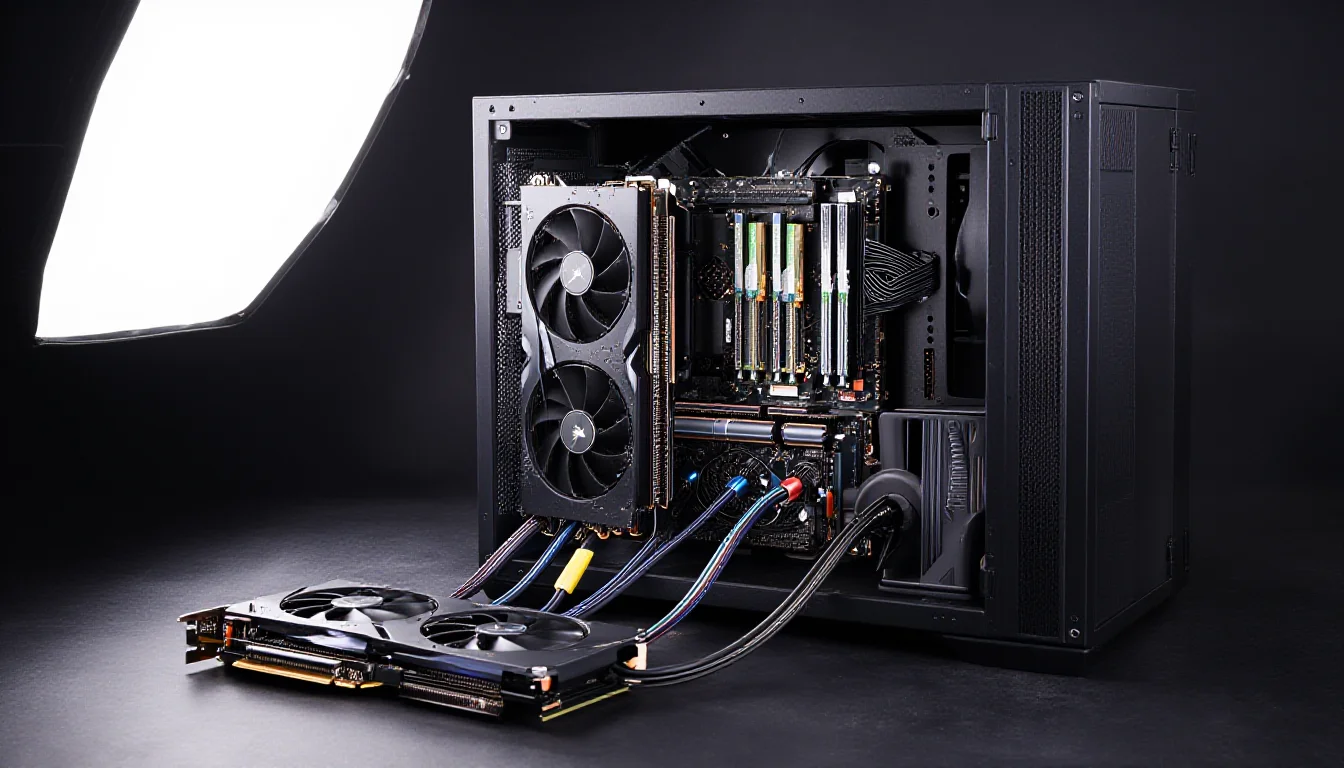
Dual RTX 3090 48 GB workstation
111.3 write tok/s with a 70B Q4_K_M kept on two cards, if the split stays even.
- Total price
- $4,200
- VRAM
- 48 GB + 64 GB System RAM
- Write tok/s
- 111.3
- Read tok/s
- 2137.6
- Load / idle power
- 850 / 120 W
- Noise
- 44 dBA
- Cost per million tokens
- 0.082
- Break-even
- 598 days
- Electricity, 4 h/day
- $317.55
- Electricity, 24 h/day
- $1,116.9
- Quant and context
- Q4_K_M · 64K
- Runtime
- CUDA
- Evidence
- Measured
Overview
Layer-split across two GA102 cards is how a 70B Q4_K_M stays off the CPU. The used pair pools 48 GB, measures 111.3 write tok/s and 2137.6 read tok/s, and draws 850 W in a tower priced at $4200. The tensor split must be even. The second slot has to be electrically x8 or better, which means a board with two CPU-direct x8 slots. A mining riser hobbles the read path by forcing KV traffic through a x1 link. Here Qwen3-Coder at Q5_K_M and both dense 70B files stay fully on the cards, and the 125B row fits at IQ3_S. Eight separate PCIe leads leave the 1200 W supply.
Best for
A desk that must keep Llama-3.3 and DeepSeek-R1 at Q4_K_M off the CPU.
Tradeoffs
The tower pulls 850 W at 44 dBA, and a second slot that is electrically narrow wastes the $4200 pair.
Bill of materials
| Role | Model | Specification | Est. street price (USD) |
|---|---|---|---|
| GPU | NVIDIA GeForce RTX 3090 (pair, used) | 2x24 GB GDDR6X | $3,000 |
| CPU | AMD Ryzen 9 7900 | 12 cores, AM5, 65 W | $219 |
| Motherboard | ASUS ProArt X670E-Creator | dual x8 from the CPU | $219 |
| Memory | Kingston 64 GB | DDR5-5600 | $169 |
| Power supply | Corsair HX1200i | 1200 W | $229 |
| Cooling | Noctua NH-D15 | dual tower | $59 |
| Chassis | Fractal Meshify 2 XL | seven slots | $139 |
| Storage | Samsung 990 Pro 2 TB | OS and model cache | $166 |
| Total | $4,200 | ||
Multi-model performance
| Model | Quant | Memory fit | Est. write tok/s | Max context |
|---|---|---|---|---|
| Qwen3.8-Flash-Next (125B MoE) | IQ3_S | Fits in VRAM | 62.4 | 24K |
| Qwen3-Coder (32B) | Q5_K_M | Fits in VRAM | 98.1 | 64K |
| DeepSeek-R1 (70B Q4) | Q4_K_M | Fits in VRAM | 48.6 | 32K |
| Llama-3.3 (70B Q4) | Q4_K_M | Fits in VRAM | 50.2 | 32K |
Assembly, BIOS, and driver checklist
- Set the tensor split to 50/50 in llama.cpp. An uneven split puts the 70B Q4_K_M back on the CPU.
- Turn on Above 4G Decoding and Resizable BAR. The primary display can be the iGPU so both cards stay on compute.
- Do not use a x1 riser. It hobbles the read path even when the cooler physically fits.
- Use the 1200 W supply with eight separate PCIe connectors. Two GA102 boards must not share a daisy-chained lead.
Questions about this build
Will Llama-3.3 70B at Q4_K_M stay off the CPU?
Yes. With an even split the Q4_K_M row is full VRAM across 48 GB, out to 32k. The same is true for DeepSeek-R1 at Q4_K_M.
Is a mining riser fine if the plug looks like x16?
No. The second slot must be electrically x8 or better from the CPU. A x1 riser serializes KV traffic and hobbles the 2137.6 read tok/s path.
Why a 1200 W supply when the measured draw is 850 W?
Because two GA102 transients stack above the published average. The HX1200i is there for eight separate PCIe connectors, not because the average draw is 1200 W.