Dual RX 6900 XT 32 GB ROCm
63 write tok/s across 32 GB, if the second 6900 XT sits on CPU lanes.
- Total price
- $2,138
- VRAM
- 32 GB + 64 GB System RAM
- Write tok/s
- 63
- Read tok/s
- 772.3
- Load / idle power
- 750 / 100 W
- Noise
- 45 dBA
- Cost per million tokens
- 0.123
- Break-even
- 1002 days
- Electricity, 4 h/day
- $273.75
- Electricity, 24 h/day
- $985.5
- Quant and context
- IQ4_XS · 32K
- Runtime
- ROCm
- Evidence
- Measured
Overview
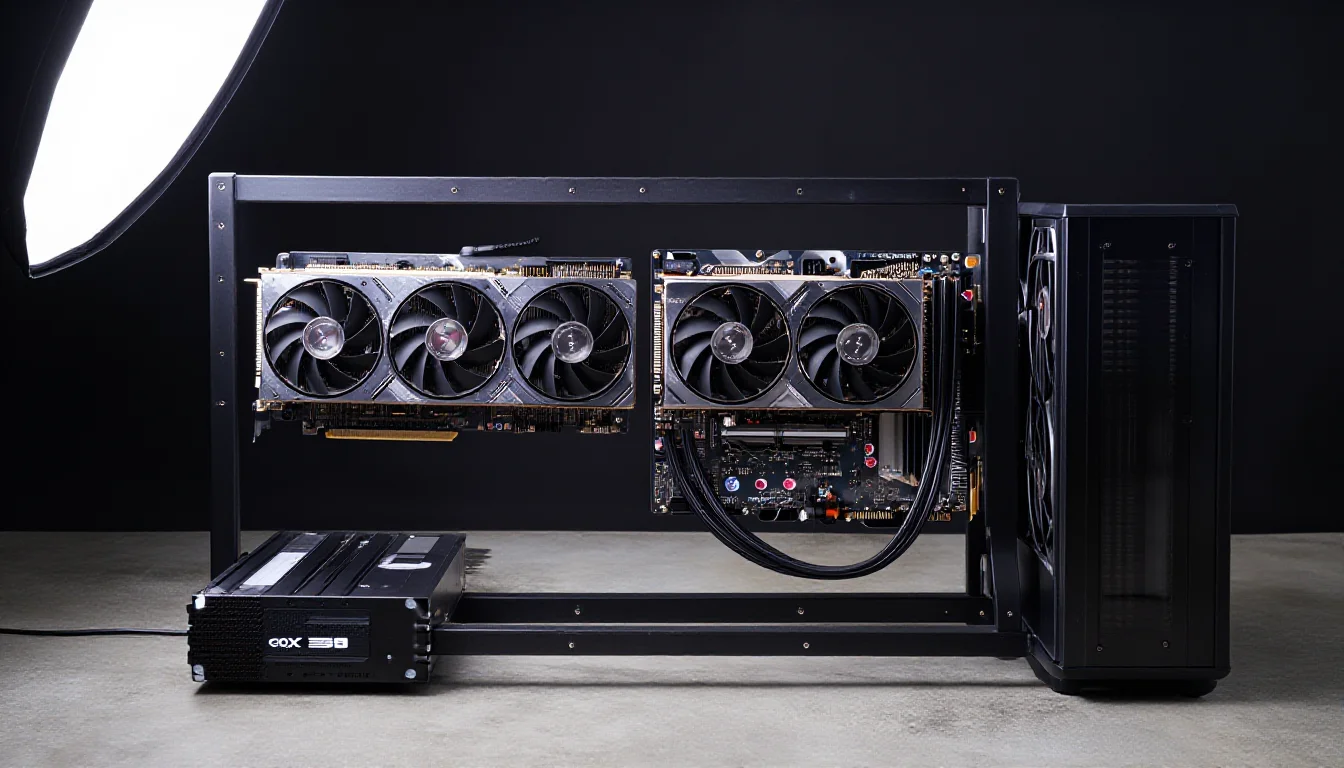
An open-air frame beats a closed dual chamber once two 300 W ASICs are layer-split. Two used Radeon RX 6900 XT boards pool 32 GB, write 63 tokens per second, read at 772.3, and draw a published 750 W for $2138. Park the second GPU on a CPU-lane slot; a chipset x4 link serializes KV traffic and makes the pair look slow. The parts list uses a Seasonic Focus GX-1000, while the build notes still ask for a 1000–1200 W PSU with separate PCIe cables and a slot of air between the boards. ROCm on Linux is the only supported runtime.
Best for
Thirty-two gigabytes of Radeon memory on Linux when you can give the second card CPU lanes and an open frame.
Tradeoffs
The pair draws 750 W, a chipset x4 slot serializes KV traffic, and ROCm will not pool the cards without HIP_VISIBLE_DEVICES plus a tensor split.
Bill of materials
| Role | Model | Specification | Est. street price (USD) |
|---|---|---|---|
| GPU | AMD Radeon RX 6900 XT (pair, used) | 2x16 GB GDDR6 | $938 |
| CPU | AMD Ryzen 9 5900X | 12 cores, AM4 | $209 |
| Motherboard | ASUS Pro WS X570-ACE | dual CPU x8 | $229 |
| Memory | Kingston 64 GB DDR4-3200 | 2x32 GB | $169 |
| Power supply | Seasonic Focus GX-1000 | 1000 W, separate PCIe cables | $239 |
| Cooling | Noctua NH-U12S | GPUs use their own coolers | $59 |
| Chassis | Open-frame mining-to-workstation chassis | spacing between the two boards | $149 |
| Storage | Samsung 980 Pro 2 TB | PCIe 4.0 OS and weights | $146 |
| Total | $2,138 | ||
Multi-model performance
| Model | Quant | Memory fit | Est. write tok/s | Max context |
|---|---|---|---|---|
| Qwen3.8-Flash-Next (125B MoE) | IQ3_S | Hybrid offload | 24.5 | 12K |
| Qwen3-Coder (32B) | Q4_K_M | Fits in VRAM | 52.8 | 32K |
| DeepSeek-R1 (70B Q4) | IQ3_S | Fits in VRAM | 26.1 | 16K |
| Llama-3.3 (70B Q4) | IQ3_S | Fits in VRAM | 27.4 | 16K |
Assembly, BIOS, and driver checklist
- The second slot must be CPU lanes. On the Pro WS X570-ACE that means the dual CPU x8 layout, not a chipset slot.
- Export HIP_VISIBLE_DEVICES and pass a tensor split. ROCm does not pool the two gfx1030 devices by itself.
- Use 1000–1200 W with separate PCIe cables. The Focus GX-1000 on this list is the floor, and a pigtail is not a second cable.
- Leave a slot of air between the two 300 W boards. An open frame is the point of this build; stacking the shrouds cooks the upper card.
Questions about this build
Can the second 6900 XT sit in a chipset x4 slot?
No. Chipset x4 serializes KV traffic. The second GPU must be on CPU lanes, which the Pro WS X570-ACE provides as dual x8.
Is 1000 W enough for the published 750 W?
Yes, when every PCIe lead is a separate cable and a slot of air stays between the two 300 W boards. The notes allow 1000–1200 W, and this list uses the Focus GX-1000.
How does llama.cpp see both GPUs under ROCm?
Export HIP_VISIBLE_DEVICES and set a tensor split so the layer split is explicit. ROCm will not pool the two cards by itself.