Dual RTX 5060 Ti 32 GB desk
67.6 write tok/s from 32 GB combined, and only after you split the work yourself.
- Total price
- $2,960
- VRAM
- 32 GB + 64 GB System RAM
- Write tok/s
- 67.6
- Read tok/s
- 1602
- Load / idle power
- 480 / 70 W
- Noise
- 36 dBA
- Cost per million tokens
- 0.079
- Break-even
- 618 days
- Electricity, 4 h/day
- $181.77
- Electricity, 24 h/day
- $630.72
- Quant and context
- IQ4_XS · 32K
- Runtime
- CUDA
- Evidence
- Measured
Overview
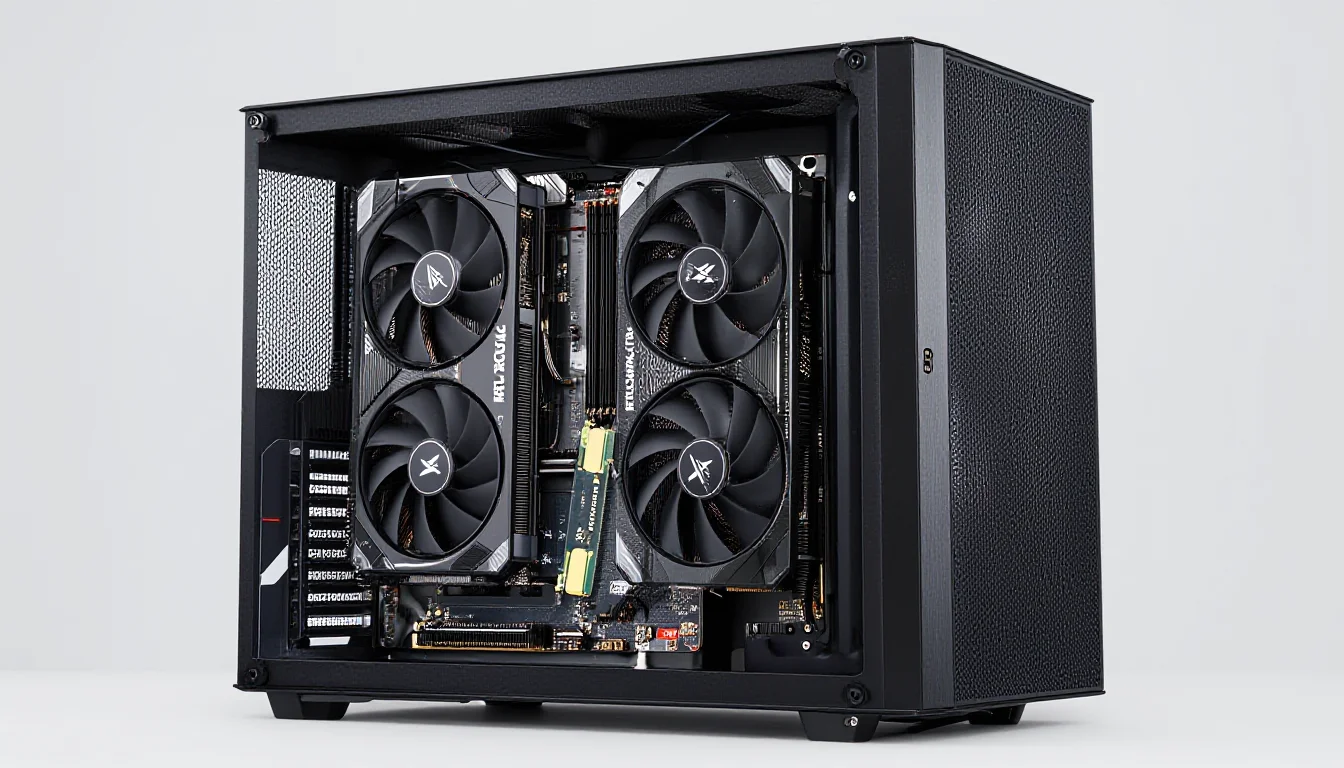
The driver will not pool these two 16 GB Blackwell boards by itself. You only see 32 GB combined after an explicit tensor split. Measured output is 67.6 write tok/s and 1602 read tok/s at 480 W, and the mid-tower costs $2960. Chassis clearance has to swallow two 2.5-slot coolers in the Lancool 216. The pair is kinder to the room than two 3090s, in both load and idle noise. A 70B Q4 is still a squeeze once the cache grows, so the published comfortable rows stay at IQ3_S with a 16k window, while Qwen3-Coder at Q5_K_M uses the pool out to 32k. The lower slot must be CPU-direct x4 at minimum, not a chipset stub.
Best for
A mid-tower that wants 32 GB of GDDR7 and a quieter room than a pair of 3090s.
Tradeoffs
The driver never pools the cards, a 70B Q4 still squeezes as the cache grows, and a chipset x2 slot quietly ruins the 1602 read path.
Bill of materials
| Role | Model | Specification | Est. street price (USD) |
|---|---|---|---|
| GPU | NVIDIA GeForce RTX 5060 Ti 16GB (pair) | 2x16 GB GDDR7 | $1,760 |
| CPU | AMD Ryzen 5 7600 | 6 cores, AM5, 65 W | $199 |
| Motherboard | ASUS TUF B650-Plus | second slot x4 from CPU or better | $189 |
| Memory | Kingston 64 GB | DDR5-6000 | $149 |
| Power supply | Corsair RM850x ATX 3.1 | 850 W | $189 |
| Cooling | Thermalright Peerless Assassin | dual tower | $49 |
| Chassis | Lian Li Lancool 216 | dual 2.5-slot clearance | $119 |
| Storage | WD SN7100 4 TB | OS and weight cache | $306 |
| Total | $2,960 | ||
Multi-model performance
| Model | Quant | Memory fit | Est. write tok/s | Max context |
|---|---|---|---|---|
| Qwen3.8-Flash-Next (125B MoE) | IQ2_XS | Hybrid offload | 29.8 | 12K |
| Qwen3-Coder (32B) | Q5_K_M | Fits in VRAM | 71.2 | 32K |
| DeepSeek-R1 (70B Q4) | IQ3_S | Fits in VRAM | 31.4 | 16K |
| Llama-3.3 (70B Q4) | IQ3_S | Fits in VRAM | 32.6 | 16K |
Assembly, BIOS, and driver checklist
- Confirm the second slot is CPU-direct x4 at minimum, not chipset x2. A chipset stub serializes the split.
- Enable Above 4G Decoding so both 16 GB framebuffers map before the context is created.
- Pass --tensor-split 1,1. The driver will not pool the two boards by itself.
- Give each card a native 12V-2x6 or 8-pin lead. Do not split both cards from one cable.
Questions about this build
Does the NVIDIA driver merge these two 16 GB cards into 32 GB?
No. You have to pass an explicit tensor split. Without --tensor-split 1,1 the second board sits idle and the pool never appears.
Is this pair easier on the room than two 3090s?
Yes. The published load is 480 W against 850 W for the dual 3090, and idle is 70 W. Chassis clearance is the remaining constraint, not the breaker.
Will a 70B Q4 stay resident once the cache grows?
No. A 70B Q4 is still a squeeze once the cache grows. The comfortable published rows are IQ3_S at 16k, while Qwen3-Coder at Q5_K_M uses the 32 GB out to 32k.