RTX 5080 balanced desk
80.7 write tok/s from 16 GB of GDDR7, as long as the Lancool 216 front can breathe.
- Total price
- $2,800
- VRAM
- 16 GB + 64 GB System RAM
- Write tok/s
- 80.7
- Read tok/s
- 3712.5
- Load / idle power
- 510 / 70 W
- Noise
- 34 dBA
- Cost per million tokens
- 0.058
- Break-even
- 393 days
- Electricity, 4 h/day
- $188.34
- Electricity, 24 h/day
- $670.14
- Quant and context
- IQ3_S · 16K
- Runtime
- CUDA
- Evidence
- Measured
Overview
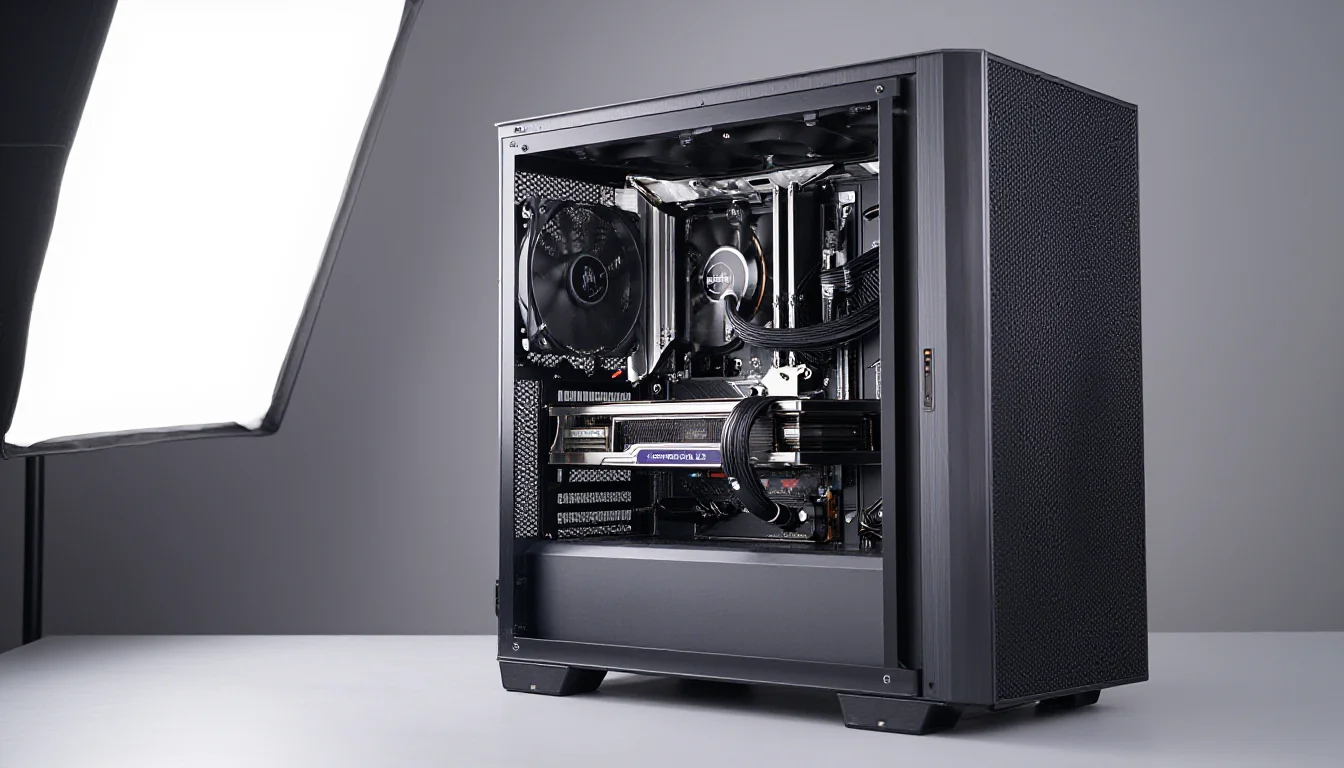
Sixteen gigabytes of GDDR7 behind a three-slot Blackwell cooler is a desk that hates sandwich cases. Generation lands at 80.7 tokens each second, prefill at 3712.5, on a 510 W system budget and a $2800 receipt. IQ3_S keeps Qwen3-Coder inside the framebuffer. Any 70B weight, DeepSeek-R1 or Llama-3.3, only moves once layers spill into 64 GB of DDR5-6000. Leave the Lancool 216 front mesh clear: that cooler drinks from the case front, and a sandwich shell blocks the stream. The TUF slot stays at PCIe Gen4, and the RM850x hands the card a native 12V-2x6 lead.
Best for
A buyer who wants 16 GB of GDDR7 for daily Qwen3-Coder and will not stuff the card into a sandwich shell.
Tradeoffs
16 GB rejects a resident 70B, the three-slot cooler dictates an open front, and 510 W is still a real desk load.
Bill of materials
| Role | Model | Specification | Est. street price (USD) |
|---|---|---|---|
| GPU | NVIDIA GeForce RTX 5080 | 16 GB GDDR7, 3-slot | $1,600 |
| CPU | AMD Ryzen 7 7700 | 8 cores, 65 W, AM5 | $249 |
| Motherboard | ASUS TUF Gaming B650-Plus | PCIe 4.0 x16 | $199 |
| Memory | Kingston Fury 64 GB | 2×32 GB DDR5-6000 | $179 |
| Power supply | Corsair RM850x ATX 3.1 | native 12V-2x6, 850 W | $159 |
| Cooling | Thermalright Peerless Assassin 120 | dual tower | $55 |
| Chassis | Lian Li Lancool 216 | 392 mm GPU clearance | $109 |
| Storage | WD Black SN7100 4 TB | PCIe 4.0, model cache | $250 |
| Total | $2,800 | ||
Multi-model performance
| Model | Quant | Memory fit | Est. write tok/s | Max context |
|---|---|---|---|---|
| Qwen3.8-Flash-Next (125B MoE) | IQ2_XS | Hybrid offload | 28.4 | 8K |
| Qwen3-Coder (32B) | IQ3_S | Fits in VRAM | 74.6 | 16K |
| DeepSeek-R1 (70B Q4) | IQ2_XS | Hybrid offload | 14.2 | 8K |
| Llama-3.3 (70B Q4) | IQ2_XS | Hybrid offload | 15.1 | 8K |
Assembly, BIOS, and driver checklist
- Lock the CPU slot at PCIe Gen4 rather than Auto. A renegotiation in the middle of a prefill drops the link and throws the context away.
- Keep the Lancool 216 front fans unobstructed. The three-slot 5080 cooler intakes from the case front, and a sandwich panel starves it.
- nvidia-smi -pl 280 holds this 360 W-class GPU under its stock target. Write speed barely moves and the hotspot falls.
- Linux uses the 570-series driver. Windows stays on the Studio branch, not a Game Ready drop.
Questions about this build
Does a 70B model fit in this 16 GB 5080?
No. Only Qwen3-Coder at IQ3_S stays resident. DeepSeek-R1 and Llama-3.3 need hybrid offload into 64 GB of DDR5.
Is the RM850x enough for the 510 W system load?
Yes. The published load is 510 W, so an 850 W ATX 3.1 unit with a native 12V-2x6 lead still has headroom for the 7700.
Why does this desk hate a sandwich case?
Because the three-slot cooler intakes from the Lancool 216 front. A sealed side chamber blocks that path and the 360 W-class board runs hot.